Real-time ambition
The “10-10-10 Challenge”
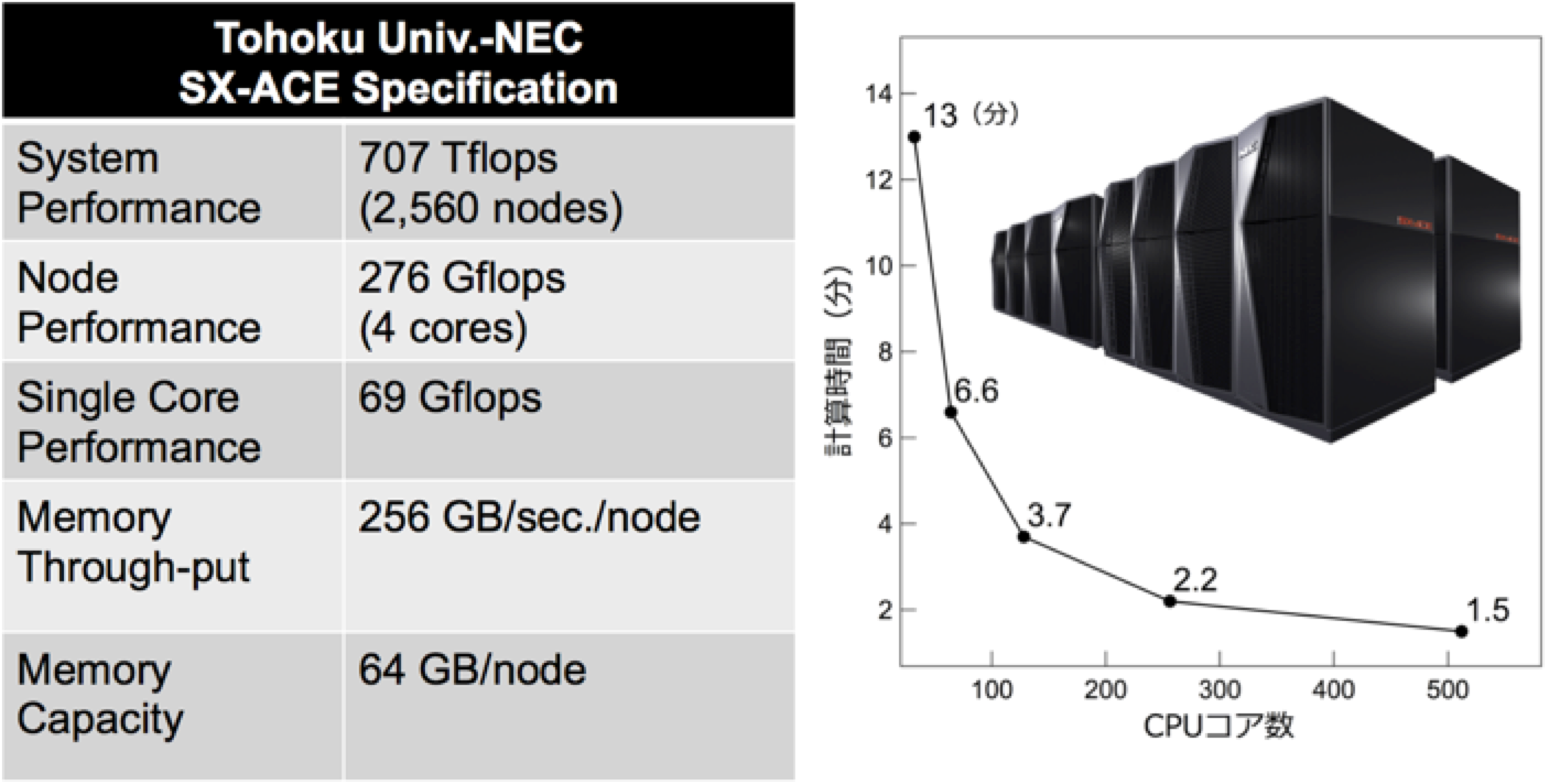
Estimate the tsunami source in roughly 10 minutes, compute inundation on a 10 m mesh in roughly 10 minutes, and deliver actionable information soon after an earthquake.
01 · Real-time assessment
Tsunami inundation and damage estimation
Using real-time earthquake information and supercomputing, we develop technology to estimate tsunami damage rapidly. The work combines source estimation, inundation computation, building exposure, and fragility functions in collaboration with university and industry partners.
02 · Large-scale scenarios
Big-data analysis for disaster mitigation
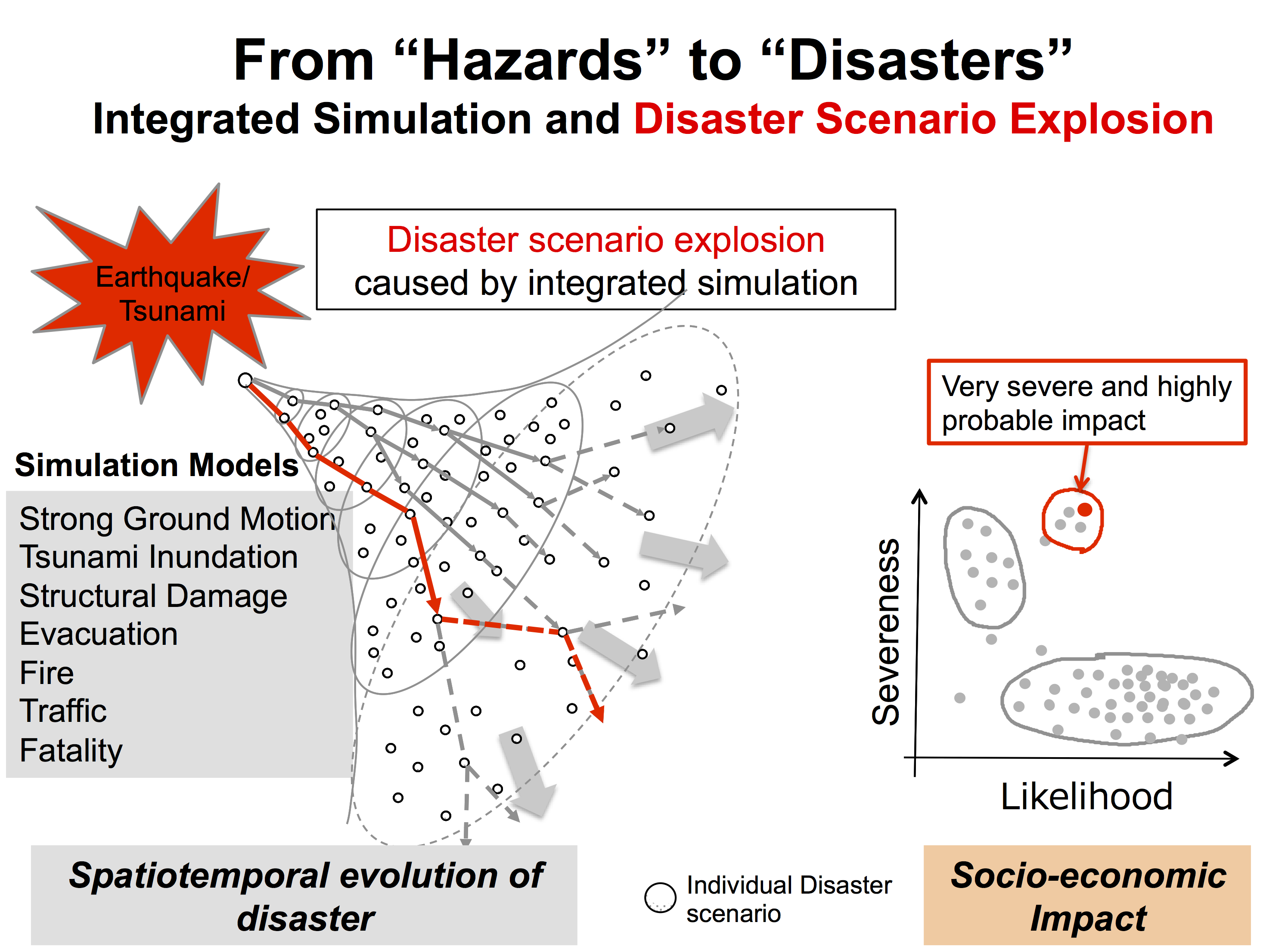
The JST CREST project brings together disaster simulation, disaster management science, mathematics, and information science. Large-scale numerical simulation and real-time data assimilation help explore the “scenario explosion” and identify measures that can reduce worst-case impacts.
03 · International applications
South American tsunami prediction
For tsunami-prone countries in Central and South America, we combine real-time computation, remote sensing, GIS, and fragility functions to assess near-field and far-field impacts and support wide-area damage estimation.

04 · Urban tsunami physics
Simulation that reproduces building damage
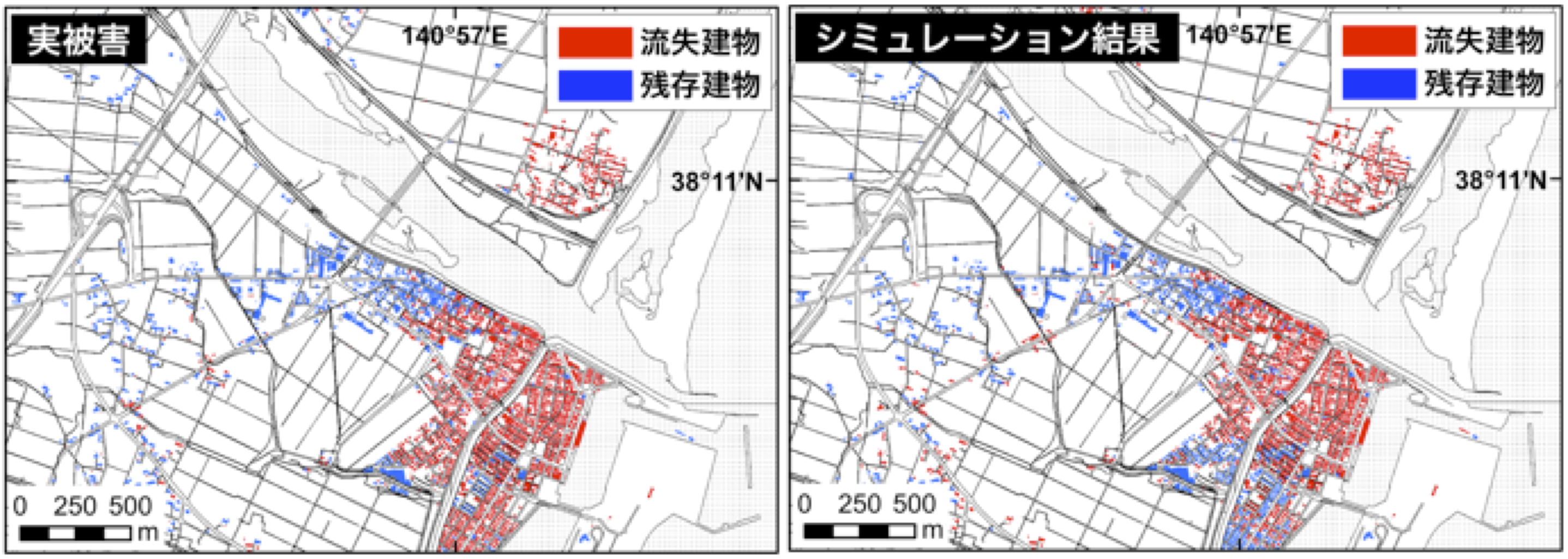
In dense urban areas, buildings obstruct flow and may be washed away as inundation progresses. A time-evolving synthetic equivalent roughness approach reproduces the changing urban surface and estimates which buildings fail, when, and how many.
05 · Next-generation methods
Lattice Boltzmann tsunami simulation
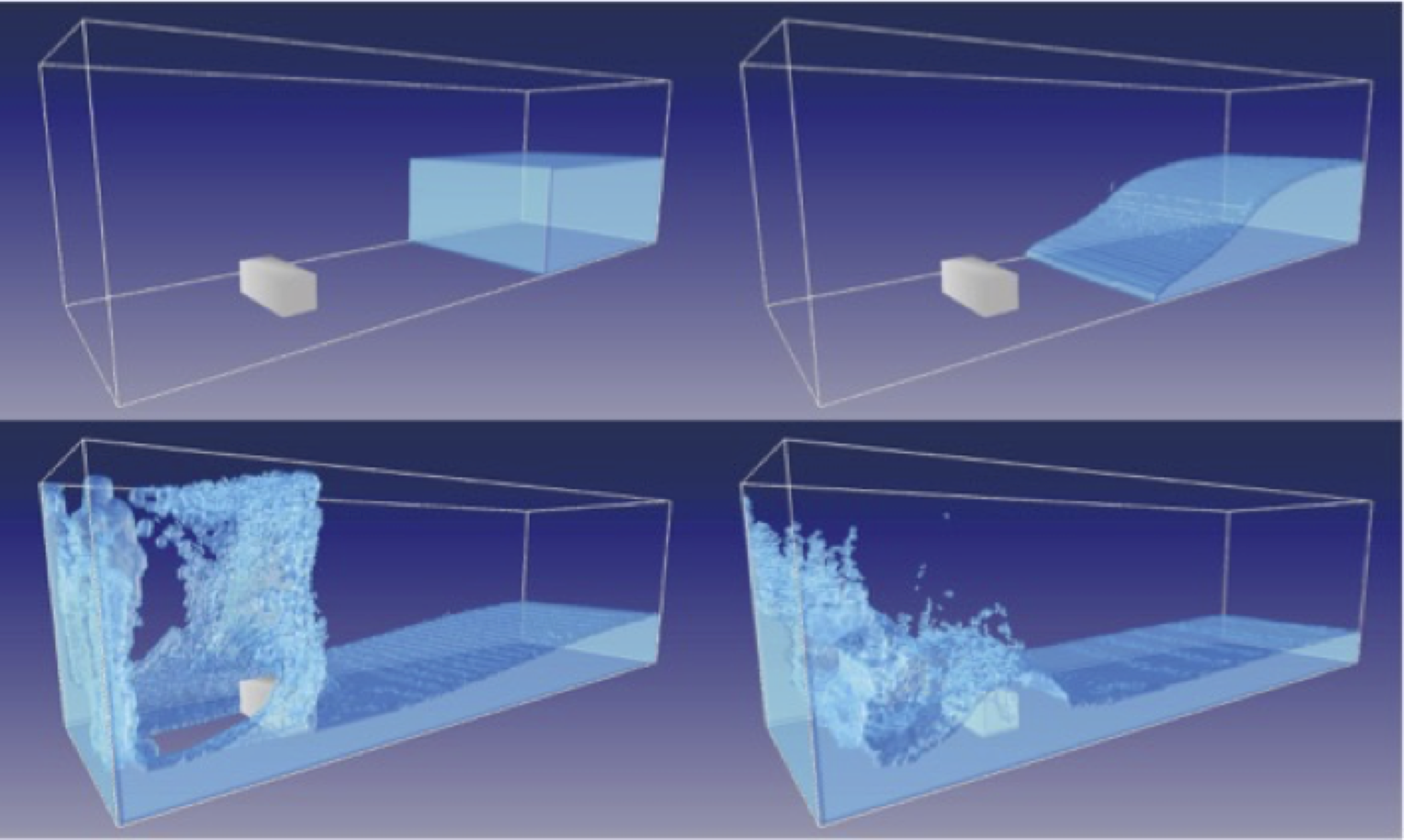
The Lattice Boltzmann method is a fully explicit scheme well suited to massively parallel computing. We explore its potential for faster urban run-up simulation while maintaining useful accuracy.
06 · Uncertainty and early warning
Rapid worst-case tsunami estimation
Immediately after an earthquake, the initial source estimate is uncertain. By exploring many possible fault arrangements, we estimate a credible worst-case tsunami scenario in minutes to support rapid assessment and evacuation decisions.
